

Inside the Foundry: How Cast Iron Is Made
Updated April 2026 | By the Rustic State Team
Every cast iron piece you've ever held — whether a skillet, a wall hook, or a towel bar — started out as liquid metal poured into a sand cavity at over 2,400 degrees Fahrenheit. The process hasn't changed all that much in the last few centuries, and that's actually the point. Cast iron's strength and character come directly from an ancient, unhurried method that modern plastics and zinc die-cast parts simply can't replicate. Here's what actually happens inside a foundry, from raw material to finished piece.

Molten iron flows at over 2,400 degrees F. Photo: Wikimedia Commons (CC BY-SA 3.0)
What Cast Iron Actually Is
Cast iron is an iron-carbon alloy — specifically, iron with a carbon content between 2% and 4%. That might sound like a small detail, but that extra carbon changes everything. It makes the metal harder and more brittle than steel, yes, but it also gives cast iron its famous ability to hold and distribute heat evenly. It's what makes cast iron heavy in your hand, and what makes it last for generations.
The carbon in cast iron exists in one of two forms depending on how the metal is cooled. In gray iron — the most common type used for cookware and hardware — the carbon separates out as graphite flakes during cooling. Those graphite flakes act as microscopic lubricants within the metal, which is part of why cast iron develops a natural non-stick surface with seasoning. Gray iron is also what gives the material its characteristic dark color and slightly rough texture.
White iron cools faster, trapping the carbon in a compound called cementite. It's extremely hard but also more brittle, so it's less common in everyday objects. Most of what you'd recognize as "cast iron" — the skillets, the hooks, the decorative hardware — is gray iron.
Step One: The Pattern
Before any metal is poured, someone has to design and build a pattern — a physical replica of the finished piece. Traditionally these were carved from hardwood like pine or mahogany, and skilled pattern-makers were among the most respected craftspeople in any foundry. Today, patterns are often machined from aluminum or created via CNC from digital designs, but the role is the same: the pattern is the template everything else is built around.
Patterns are made slightly larger than the intended final product, accounting for the fact that metal shrinks as it cools. A cast iron piece typically shrinks about 1% in volume during solidification, so the pattern has to compensate for that. This is called the "shrinkage allowance," and getting it wrong means your finished piece comes out the wrong size. Pattern making is still a craft that demands a lot of experience to get right.
Step Two: Making the Sand Mold
Sand casting is the dominant method for making cast iron parts, and it's been used for thousands of years — the Chinese were sand-casting iron tools around 500 BCE. The core idea is elegantly simple: press a pattern into a mixture of sand, clay, and water to form a cavity, remove the pattern, and pour molten metal into the space it left behind.
A prepared sand mold before pouring. Photo: Wikimedia Commons (CC BY-SA 4.0)
The sand used in foundries isn't ordinary beach sand. It's a specific blend called green sand — not because of its color but because it contains moisture. The mix is typically around 85 to 90 percent silica sand, 5 to 10 percent clay as a binder, and 3 to 5 percent water. The clay makes the sand cohesive enough to hold its shape under the pressure of molten metal, while the water gives it workability.
The mold is made in two halves: the cope on top and the drag on the bottom. The pattern is pressed into each half, packed with sand, and then the halves are separated to remove the pattern. What's left is a precise cavity in the shape of your finished piece. Channels called gates and sprues are cut into the sand to allow the metal to flow in, and risers — extra reservoirs of metal — are added to feed the cavity as the iron contracts during cooling.
For pieces with internal features — a hook's mounting holes, for example, or a hollow section — foundry workers add cores, which are pre-formed sand shapes placed inside the mold before it's closed. The molten metal flows around them, and the cores are broken out after casting.
Step Three: Melting the Iron
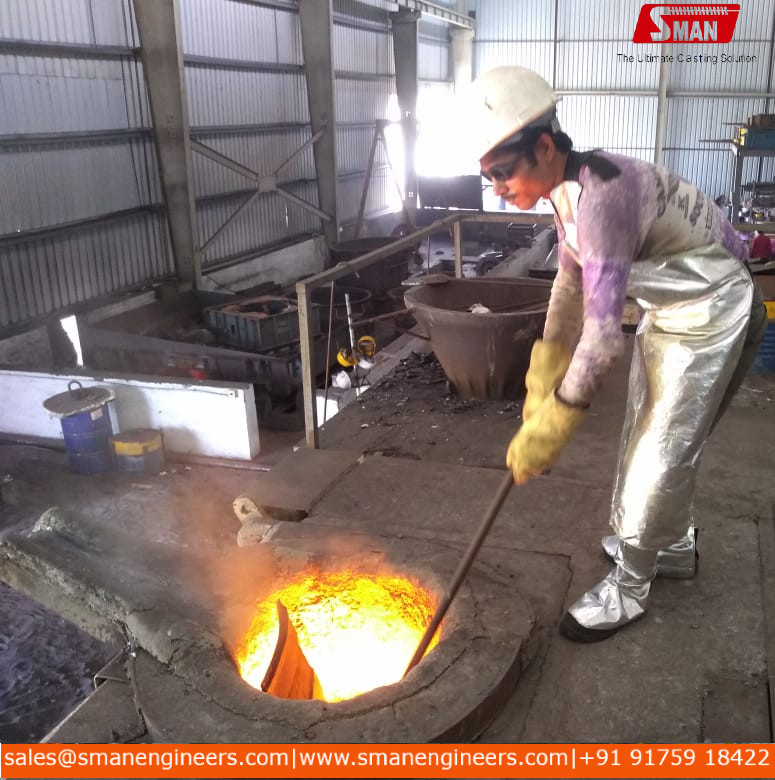
Modern foundries melt iron in electric induction furnaces, which use electromagnetic fields to generate heat within the metal itself. A large foundry furnace can hold 10 metric tons of metal and reach temperatures above 2,600 degrees F. It takes roughly 45 minutes to fully melt a 22,000-pound charge.
The charge — the mix of raw materials going into the furnace — typically combines pig iron, recycled cast iron scrap, steel, and small amounts of alloys. Pig iron is the direct output of a blast furnace, where iron ore is reduced with coke and limestone. It's high in carbon and other impurities, so the foundry chemist adjusts the mix to hit the target carbon content for the final product. Silicon, manganese, and sulfur levels are all carefully controlled.
Before pouring, the molten iron is tested — usually with a small sample poured into a test mold and analyzed — to confirm the chemistry is right. If the carbon content is off or there's too much sulfur, the batch gets adjusted. Getting the chemistry wrong produces weak or brittle castings, so this step matters enormously.
Step Four: The Pour
Once the iron hits the right temperature and chemistry, the pour begins. Molten iron is transferred from the furnace into a large ladle — sometimes by crane, sometimes on a track system — and then carefully poured into the waiting sand molds. The iron glows a brilliant orange-white and throws off intense radiant heat. Foundry workers wear heavy protective gear: face shields, heat-resistant jackets, and leather gloves.
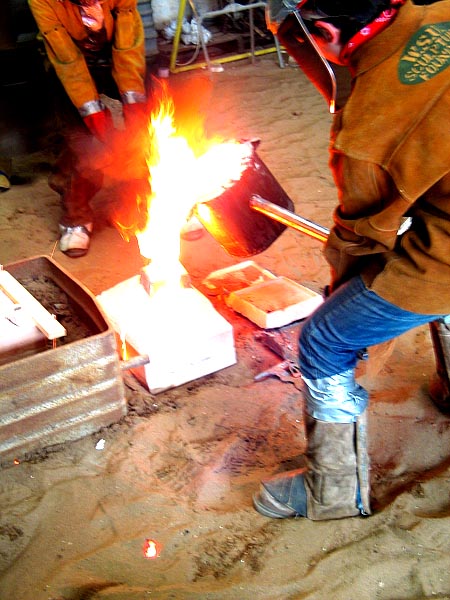
Pouring molten iron into a sand mold. Photo: Wikimedia Commons (CC BY-SA 3.0)
The pour has to be steady and controlled. Too slow and the metal starts to cool before the cavity is filled, creating cold shuts — seams where two flows of metal met but didn't bond. Too fast and you create turbulence, trapping air bubbles that show up as porosity defects in the finished piece. Experienced pourers develop a feel for the rate over years of practice — it's a skill that's genuinely hard to automate.
One thing that makes sand casting so well-suited for cast iron specifically is the silica sand's melting point, which is around 3,100 degrees F — well above cast iron's pouring temperature. The mold holds its shape perfectly, capturing every detail of the pattern cavity in the finished casting.
Step Five: Shakeout and Cleaning
After pouring, the molds are left to cool. Depending on the size of the casting, this can take anywhere from 30 minutes to several hours. Then comes shakeout — the molds move onto a vibrating conveyor that shakes the sand apart, and the rough casting tumbles out. The sand, still warm, is collected, reconditioned with fresh clay and water, and recycled back into new molds. A well-run foundry wastes almost nothing.
The casting at this stage is far from finished. It's rough, covered in residual sand, and still has the gates and risers attached — the extra bits of metal that fed the cavity during cooling. These are broken or cut off, and the casting goes through shot blasting: a process where steel shot is hurled at the surface to strip away sand, scale, and surface irregularities. After shot blasting, the surface has the characteristic matte, slightly textured appearance that most people associate with raw cast iron.
Step Six: Finishing and Inspection
Finishing is where the piece gets its final character. Gates are ground smooth. Parting lines — seams left where the two halves of the mold met — are cleaned up. For decorative hardware, this can involve hand-grinding and polishing to ensure edges are clean and surfaces are consistent. Some foundries apply coatings at this stage: a powder coat for color and rust protection, a wax finish, or a baked oil seasoning for cookware.
Then inspection. Every casting is checked visually for cracks, voids, and misruns. Dimensional checks verify the piece came out to spec. For critical applications, foundries use X-ray or ultrasonic testing to check for internal defects that aren't visible from the outside. A rough-looking casting that's structurally sound is fine; a casting with hidden porosity or cold shuts is scrapped.
The reject rate in a good foundry is typically low — experienced foundry workers catch problems early, in the mold-making and pouring stages, before they become expensive scrap. But it's nonzero. Every foundry accepts that some percentage of castings won't make the cut, and that's built into the process.
Why This Process Produces Something Different
What comes out of a foundry is genuinely different from what comes out of a die-casting machine or an injection mold. Die-cast zinc alloy — the material in most cheap bathroom hardware — is injected into a metal mold under high pressure. It's fast, precise, and cost-effective, but the resulting material is lightweight, susceptible to corrosion, and doesn't have the density or thermal mass of cast iron.
Cast iron's weight is a feature, not a flaw. That density is what makes it feel substantial in your hand, what anchors it to a wall without flexing, and what keeps a towel bar from rattling loose over years of use. The rougher texture of cast iron's surface also bonds better with coatings and patinas, meaning the finish holds up longer than on smooth die-cast parts.
There's also the simple fact that cast iron doesn't corrode the way coated metals do. When zinc hardware starts to pit and flake, it's essentially done. Cast iron, properly cared for, just develops character — a light patina that doesn't compromise the structure at all.
A Process Worth Understanding
Next time you pick up a piece of cast iron — whether it's a pan, a hook, or a piece of decorative hardware — it's worth appreciating what went into making it. The raw materials were melted at temperatures that would vaporize water. A skilled worker poured liquid metal by hand into a sand mold shaped specifically for that object. The piece was broken out of the mold, cleaned, inspected, and finished before it ever reached a store shelf.
That's not an especially fast or cheap process compared to modern alternatives. But it produces something that's genuinely built to last — and that's increasingly rare.